
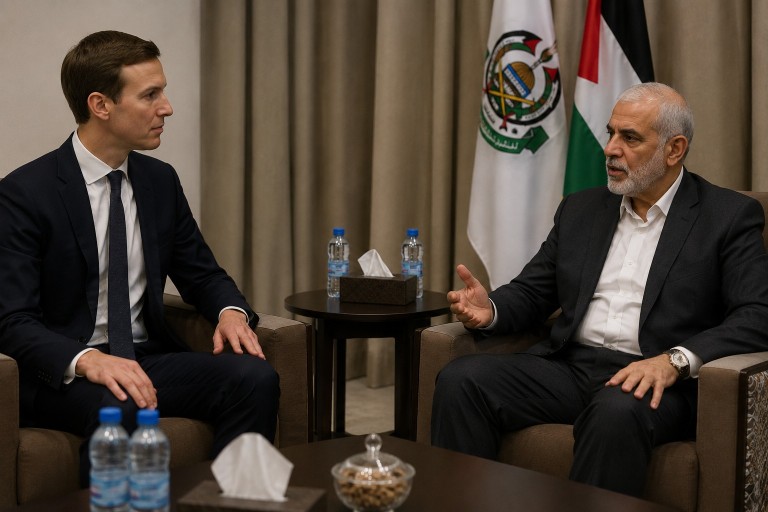
On Sunday, Jared Kushner, the son-in-law and envoy of former U.S. President Donald Trump, held discussions with Khalil al-Hayya, the political chief of Hamas, in Egypt. This engagement is part of a renewed diplomatic initiative by the United States aimed at reviving a stalled ceasefire plan for Gaza. The meeting served as a precursor to Kushner’s scheduled meeting with Israeli Prime Minister Benjamin Netanyahu. Netanyahu recently turned down a U.S.-endorsed 15-point plan designed to guide the next steps in the ceasefire process.
The proposed plan aims for Hamas to gradually disarm while Israel suspends military activities and retreats from certain areas of Gaza. It also outlines plans for rebuilding and the deployment of international forces to ensure security. Hamas has expressed its commitment to the roadmap but insists that Israel must first cease its attacks and withdraw to the agreed-upon “yellow line” before the plan can proceed. The group has further linked the relinquishment of its heavier weaponry to advancements toward establishing a Palestinian state—an idea that Netanyahu’s government opposes.
Netanyahu, on the other hand, maintains that a complete withdrawal of Israeli forces from Gaza will only be possible once Hamas is fully disarmed. This disagreement has stalled significant parts of the ceasefire plan, including reconstruction efforts and the deployment of international peacekeeping forces. Kushner’s meeting with Hamas, which included officials from Egypt, Qatar, and Turkey, aimed to secure Hamas’s agreement to the plan, particularly concerning disarmament, ahead of his talks with Netanyahu.
In addition to his meeting with Netanyahu, Kushner is anticipated to hold discussions with former British Prime Minister Tony Blair and Nickolay Mladenov, the director of the Board of Peace. Several countries in the region, such as Saudi Arabia, the United Arab Emirates, Jordan, Pakistan, and Indonesia, have openly criticized Israel’s rejection of the U.S.-backed roadmap and have called for swift action to prevent further delays in the peace process.
This diplomatic effort is taking place as Netanyahu faces political challenges ahead of Israel’s elections in October. His governing coalition includes ministers advocating for a more stringent stance on Gaza, casting uncertainty over the future of the ceasefire plan. With regional tensions and political pressures mounting, the outcome of these talks remains highly consequential for the stability of the region.