
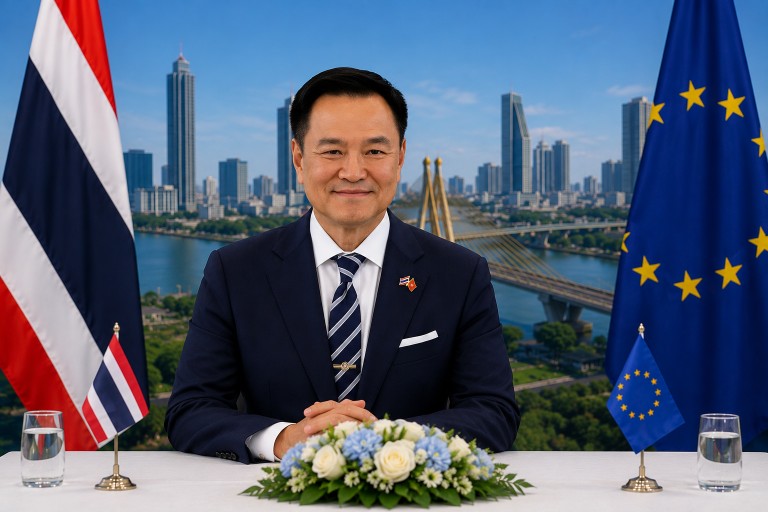
In a significant move to bolster economic ties between Thailand and the European Union, Thai Prime Minister and Interior Minister Anutin Charnvirakul recently engaged in discussions with leaders from the EU–ASEAN Business Council (EU-ABC) and the European Association for Business and Commerce (EABC). The talks focused on enhancing trade, investment, and broader economic collaboration, reflecting the importance of these relationships to Thailand’s economic strategy.
The high-profile meeting featured participation from representatives of over 40 leading European corporations. These companies span diverse industries including healthcare, finance, automotive, energy, technology, agriculture, tourism, and consumer goods, illustrating the wide-ranging nature of potential investment and cooperation avenues.
Anutin underscored the European Union’s status as a vital economic partner for Thailand. He unveiled the government’s tripartite strategy aimed at increasing the nation’s competitive edge. This strategy includes advancing infrastructure in digital technology, artificial intelligence, and clean energy. Additionally, it focuses on enhancing transport and logistics systems and improving the investment climate through regulatory reforms, as well as progressing Thailand’s aspirations to join the Organisation for Economic Co-operation and Development (OECD).
Further emphasizing its strategic goals, Thailand is set to position itself as a dominant player in various sectors. The government is keen on establishing the country as a regional hub for semiconductor manufacturing, clean energy, artificial intelligence, digital technology, life sciences, modern agriculture, and food production. This strategic positioning is intended to attract more European investments and collaborations in these high-growth sectors.
The meeting also reinforced Thailand’s commitment to finalizing the Thailand–EU Free Trade Agreement. This agreement is anticipated to significantly enhance market access for Thai products, thereby broadening business opportunities with the European Union and cementing economic ties between the two regions.